
A small crack in a Tucson block wall can look harmless at first. Then the crack begins following the mortar joints, a gap appears beside a column, or the top of the wall no longer looks straight. At that point, the important question is not simply, “How do I fill the crack?” It is, “Why is the wall moving?”
Block walls in Tucson can crack or lean because of footing settlement, soil movement, drainage problems, monsoon runoff, heat-related movement, inadequate reinforcement, deteriorated mortar, tree roots, or impact damage. A minor, stable mortar crack may need localized repair, while stair-step cracks, separation from columns, bulging, or visible leaning usually require an on-site inspection before the correct solution can be chosen.
BrickRight Tucson is a local masonry contractor serving Tucson and nearby Southern Arizona communities. With more than 15 years of stated local experience, the company provides block-wall repair, concrete-block installation, brick and stone masonry, slump-block work, pavers, retaining walls, and chimney masonry.
For an inspection or estimate, call (520) 462-7697 or contact BrickRight Tucson.
Why Do Block Walls Crack in Tucson?
Most block-wall cracks develop because the wall, its footing, or the soil beneath it is moving. The shape and location of the crack can provide useful clues, but a crack pattern alone cannot confirm the cause.
A masonry wall works as a system. The concrete blocks, mortar joints, footing, rebar, grout, columns, drainage, and surrounding soil all affect one another. Repairing only the visible crack may not work if movement continues underneath it.
Common causes of block wall cracks in Tucson include:
- Uneven footing settlement
- Erosion near the base of the wall
- Irrigation leaks
- Poor property drainage
- Monsoon runoff
- Inadequate reinforcement
- Weak connections between walls and columns
- Heat-related expansion and contraction
- Shrinkage within the masonry
- Tree-root pressure
- Vehicle or equipment impact
- Aging or deteriorated mortar
The right repair begins with identifying which of these conditions is affecting the wall.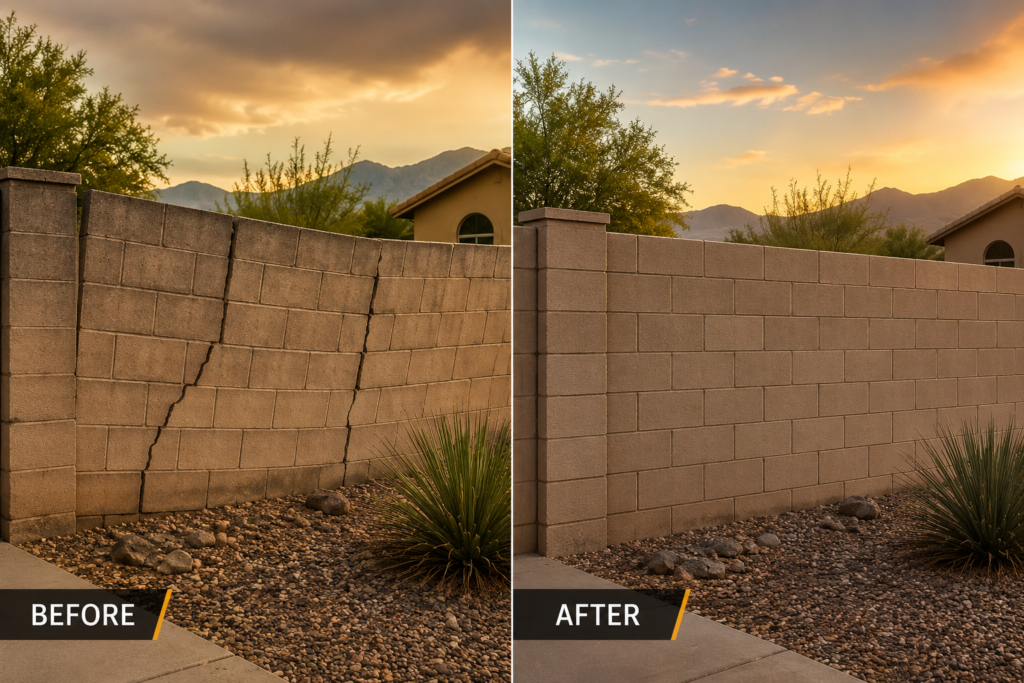
What Different Block-Wall Crack Patterns May Mean
Crack patterns help determine whether a wall may need monitoring, localized repair, reinforcement, or rebuilding. They should be considered together with visible movement, wall function, footing condition, and whether the damage is becoming worse.
Crack or damage pattern | What it may indicate | Recommended response |
Fine hairline crack | Minor shrinkage or surface movement | Photograph, monitor, and request an assessment if it grows |
Stair-step crack | Differential settlement or footing movement | Inspect the footing, soil, and drainage |
Vertical crack | Shrinkage, settlement, or separation | Check whether the crack is widening or displaced |
Horizontal crack | Lateral pressure, reinforcement trouble, or movement | Arrange an on-site inspection |
Crack through the blocks | More significant wall movement | Professional assessment recommended |
Gap beside a column | Failed connection or uneven movement | Inspect the wall-column connection and footing |
Leaning or bowing wall | Footing failure, pressure, or inadequate reinforcement | Prompt on-site inspection |
Loose or falling blocks | Advanced deterioration or instability | Keep people away and arrange immediate assessment |
Crumbling mortar joints | Age, moisture exposure, or mortar deterioration | Evaluate for repointing or localized rebuilding |
White powdery deposits | Moisture moving through the masonry | Identify and correct the moisture source |
The Concrete Masonry & Hardscapes Association notes that differential settlement commonly creates stair-step cracking along mortar joints. It also emphasizes that footing design and suitable supporting soil are central to preventing settlement-related cracks.
Is a Leaning Block Wall Dangerous?
A visibly leaning, bulging, or separating wall should not be treated as a cosmetic problem. The farther a wall moves out of alignment, the greater the concern that its footing, reinforcement, connections, or supporting soil may no longer be performing correctly.
Keep children, pets, vehicles, and stored items away from the wall when you notice:
- A lean that is visible without measuring
- A section moving after rain
- Loose blocks along the top
- Separation from a column or adjoining wall
- Falling mortar or masonry pieces
- Bulging in the middle of the wall
- Cracks that are widening
- A retaining wall pushing outward
- Movement near a gate opening
- A wall that rocks or shifts when lightly touched
Do not attempt to push a leaning wall back into position. A contractor needs to determine whether it can be stabilized or whether the affected section must be dismantled and rebuilt.
Call BrickRight Tucson at (520) 462-7697 for a block-wall assessment in Tucson.
When a Photo Estimate Works—and When You Need an Inspection
Photos can support an initial budget range for minor damage, but structural movement requires an on-site inspection. A picture cannot always reveal footing depth, internal reinforcement, erosion beneath the wall, or pressure behind a retaining structure.
Wall condition | Best next step |
Small hairline crack with no movement | Send photos for an initial assessment |
Minor deteriorated mortar | Photos may support early budgeting |
One chipped or damaged block | Send wide and close-up photos |
Wide or growing crack | Schedule an on-site inspection |
Stair-step crack | Schedule an on-site inspection |
Crack passing through blocks | Schedule an on-site inspection |
Separation beside a column | Schedule an on-site inspection |
Visible leaning or bowing | Prompt on-site inspection |
Wall retaining soil | On-site inspection required |
Recurring crack after previous repair | Diagnose the underlying cause in person |
New block-wall installation | Site measurements and layout review required |
Photos to Send for a Faster Assessment
Take the following pictures in daylight:
- A wide photograph showing the complete wall
- A side-angle photograph showing any lean
- Close-up photographs of each crack
- A photograph of the wall base and surrounding soil
- A photograph showing irrigation lines, downspouts, or drainage
- A photograph of nearby columns and gate openings
- A photograph showing property access for workers and materials
Include approximate wall length, height, and thickness when requesting an estimate.
Why Tucson Soil and Footing Movement Matter
A masonry wall is only as stable as the footing and soil supporting it. When one part of the base settles more than another, the wall may crack along mortar joints, separate near columns, or begin leaning.
Possible warning signs of footing movement include:
- Stair-step cracks
- A gap that becomes wider toward the top
- One wall section sitting lower than another
- Separation where the wall meets a column
- A gate that no longer closes correctly
- Repeated cracking after patch repairs
- Visible erosion near the footing
Tucson properties do not all have identical soil conditions. Compaction, grading, localized clay, fill soil, caliche, irrigation, and previous construction can create different conditions even within the same neighborhood.
A professional assessment should focus on what is happening at the specific property rather than assuming every Tucson block wall fails for the same reason.
How Heat Affects Concrete Block Walls
Tucson’s heat does not automatically mean a wall will crack, but temperature and moisture changes can contribute to masonry movement. Long wall sections need suitable construction details to accommodate normal movement and maintain stability.
Cracking may be more likely when a wall has:
- Long uninterrupted sections
- Inadequate control joints
- Weak wall-to-column connections
- Insufficient reinforcement
- Deteriorated mortar
- Existing footing movement
- Dark finishes exposed to intense sunlight
- Previous repairs using incompatible materials
The correct repair depends on whether the crack is limited to the finish, follows a mortar joint, passes through blocks, or is accompanied by displacement.
How Monsoon Runoff and Drainage Affect Block Walls
Heavy runoff can aggravate an existing footing or drainage problem by eroding soil, saturating weak areas, or increasing pressure behind a retaining wall. Water is often a contributing condition rather than the only cause of failure.
The National Weather Service explains that Southern Arizona’s monsoon includes periods of heavy rain and that precipitation can vary considerably across the region.
Inspect these areas before and after heavy rain:
- Soil washed away from the wall base
- Standing water near the footing
- Irrigation spraying directly onto the wall
- Downspouts discharging beside the wall
- Water flowing through cracks
- Blocked retaining-wall drainage
- New gaps or movement
- Damp areas that remain wet
- White mineral deposits on the masonry
A crack repair may fail again if the water source and soil erosion are not addressed.
Repair, Reinforce, or Rebuild?
Minor, stable damage may be repairable without demolition. A wall that has moved substantially or has a failed footing may require partial or complete rebuilding.
Localized Repair
Localized repair may be appropriate when:
- The wall remains straight
- The footing appears stable
- Damage is limited to a small area
- Mortar joints have deteriorated
- One or two blocks are damaged
- The crack is not widening
- There is no significant displacement
The work may include removing loose mortar, repointing joints, replacing damaged blocks, and matching the existing finish.
Reinforcement or Stabilization
Reinforcement may be considered when:
- The wall is generally stable but has weak connections
- A localized section needs added support
- Existing columns or pilasters can be incorporated into the solution
- The footing remains serviceable
- An engineered repair method is appropriate
The exact method depends on wall height, function, reinforcement, soil conditions, and local requirements.
Partial Rebuild
A partial rebuild may be the better choice when:
- One section is leaning
- Several blocks are cracked or displaced
- The wall has separated from a column
- Localized footing correction is required
- Previous crack repairs have failed
- The surrounding wall remains serviceable
The affected section can be carefully removed, the supporting conditions corrected, and the wall rebuilt to match adjoining masonry.
Full Replacement
Full replacement may be more practical when:
- Damage affects most of the wall
- Multiple sections are leaning
- The footing is widely inadequate
- Reinforcement is missing or badly deteriorated
- The wall no longer meets the property’s needs
- Repeated repairs would cost nearly as much as replacement
Homeowners comparing repair with replacement can also review BrickRight Tucson’s concrete-block installation service.
Quick Repair-or-Rebuild Decision Flow
Use this simple guide as a starting point:
Small crack with no movement
→ Photograph it, monitor it, and request an initial masonry assessment.
Deteriorated mortar but stable blocks
→ Localized mortar-joint repair may be enough.
One or two broken blocks
→ Individual block replacement may be possible.
Stair-step crack
→ Inspect the footing, supporting soil, and drainage.
Wall separating from a column
→ Check the connection and determine whether the wall has moved.
Wall leaning or bowing
→ Arrange a prompt on-site inspection.
Cracked retaining wall
→ Inspect the wall, drainage, soil pressure, and reinforcement.
Crack returns after repair
→ Diagnose the cause before applying another patch.
Large section with footing failure
→ Compare a partial rebuild with full replacement.
Block Wall Repair Costs in Tucson
The cost depends more on the cause and repair method than on the visible length of the crack. Minor repairs may cost a few hundred dollars, while substantial structural work or rebuilding may cost several thousand dollars.
Type of work | Broad planning range | Common cost factors |
Minor mortar or crack repair | Often a few hundred dollars | Access, crack length, mortar matching |
Localized block replacement | Project-specific | Number of blocks, finish, reinforcement |
Partial wall rebuilding | Often several thousand dollars | Demolition, footing, rebar, grout, disposal |
Leaning-wall correction | Site-specific | Degree of movement, footing, wall height |
Retaining-wall repair | Site-specific | Drainage, soil pressure, engineering |
Full block-wall replacement | Site-specific | Length, height, footing, finish, permits |
BrickRight Tucson’s existing cost guide also explains that small surface repairs and major structural rebuilding have very different price levels.
For a deeper cost breakdown, read the block wall repair cost guide for Tucson.
A Typical Tucson Block-Wall Repair Scenario
A homeowner notices stair-step cracks near a wall column. From the front, the damage appears limited to the mortar joints. A side view shows that the wall has also moved outward.
The inspection finds three connected problems:
- Soil has eroded near part of the footing
- Irrigation water has repeatedly collected near the wall
- The affected section has separated from its supporting column
Simply filling the cracks would improve the appearance without correcting the movement.
A more complete repair may include:
- Removing the unstable wall section
- Excavating around the affected base
- Correcting the supporting footing conditions
- Improving drainage or irrigation discharge
- Installing suitable reinforcement
- Rebuilding the wall section
- Matching the existing block, mortar, and finish
- Removing debris and cleaning the property
What the Before-and-After Photos Should Show
- A wide view of the complete damaged section
- A side angle clearly showing the lean
- A close-up of the stair-step cracks
- The footing and erosion before repair
- Reinforcement during reconstruction
- The completed wall with aligned blocks
- The repaired finish beside the original masonry
This type of visual evidence helps homeowners understand why a structural rebuild costs more than filling a visible crack.
Learn more about block wall repair in Tucson.
Common Block-Wall Repair Mistakes
The most expensive mistake is repairing the appearance without diagnosing the cause.
Avoid:
- Painting over an active crack
- Using drywall spackle on exterior masonry
- Filling a moving joint without inspecting the footing
- Ignoring irrigation or drainage problems
- Rebuilding blocks over an unstable base
- Assuming every crack is harmless
- Assuming every crack requires complete replacement
- Comparing a cosmetic repair quote with a structural rebuild quote
- Hiring without checking the contractor’s credentials
- Accepting a verbal estimate without a written scope
- Failing to ask whether debris removal is included
- Waiting until loose blocks begin falling
A low quote is not necessarily better value if footing work, reinforcement, drainage, cleanup, or finish matching has been excluded.
Do You Need a Permit to Repair or Rebuild a Block Wall in Tucson?
Permit and zoning requirements depend on wall height, location, function, and project scope. A small localized repair may be treated differently from constructing a new wall, increasing its height, or rebuilding a wall that retains soil.
The City of Tucson states that fences and walls require zoning review and that engineered plans may be necessary depending on height or retaining-wall function. Property location, historic status, setbacks, and private HOA restrictions may also affect the project. Review current requirements through the City of Tucson Planning and Development Services before work begins.
Projects outside Tucson city limits may fall under a different authority, including Pima County or another municipality.
When Should a Structural Engineer Be Involved?
A masonry contractor can assess many common block-wall problems. Engineering input may be appropriate when:
- The wall retains substantial soil
- Movement is severe or widespread
- The wall supports another structure
- The footing failure is unclear
- The proposed repair requires calculations
- The wall is unusually tall
- The property is commercial or a residential rental
- The wall affects neighboring structures
- Local permitting officials require engineered plans
The goal is to select a repair that matches the wall’s actual function and risk—not to overcomplicate a minor repair or underestimate structural movement.
Questions to Ask a Tucson Block-Wall Contractor
Before hiring, ask:
- What do you believe caused the cracking or movement?
- Is the footing stable?
- Does the wall need repair, reinforcement, or rebuilding?
- Will drainage or irrigation changes be required?
- What masonry materials will be used?
- How will the new work match the existing wall?
- What reinforcement is included?
- Does the price include demolition and disposal?
- Are permits or engineering required?
- Who is responsible for obtaining permits?
- What could change the final price?
- How long should the work take?
- What warranty applies?
- Can you provide a written scope?
- Can I verify your Arizona contractor license and insurance?
BrickRight Tucson describes its process as an on-site assessment, clear project planning, material selection, professional installation, and final inspection.