
3 Signs Your Block Wall Needs Professional Masonry Repair
Most block walls do not fail overnight. The damage builds quietly, a small crack here, a slight lean there, until what started as a minor eyesore becomes a genuine safety risk. By the time most property owners notice something is wrong, the repair cost has already grown far beyond what it needed to be.
Arizona accelerates everything. Intense heat, monsoon moisture, and unstable desert soil push block walls harder than almost any other climate in the country. A hairline crack in spring can become a structural problem before the monsoon season ends.
This guide walks you through the real warning signs that your concrete block or cinder block wall needs professional attention, and why acting early is always the smarter financial decision.
If you want to understand what causes these problems in the first place, our related guide, Why Block Walls Crack in Tucson Backyards, covers the root causes in full detail.
Not Every Crack Means the Same Thing
Cracks are not all created equal. Some are purely cosmetic. Others are warning you that something serious is happening inside or beneath the wall, and knowing the difference matters before you decide what to do next.
Surface shrinkage cracks are shallow and random. They appear in older walls and are worth monitoring, but rarely urgent. Stair-step cracks that follow mortar joints diagonally are more concerning; they usually mean different sections of the wall are settling at different rates. That pattern almost always worsens without intervention.
Horizontal cracks are the most serious. On any block retaining wall or cinder block wall, a horizontal crack means the wall is being pushed laterally, usually by soil pressure, water buildup, or both. This is a structural warning that needs professional eyes immediately, not a patch job and a wait-and-see approach.
Vertical cracks can go either way depending on their width, location, and whether they are actively growing. A professional mason considers the full picture and determines whether the crack itself is the problem or simply a symptom of something deeper beneath the surface.
Signs Your Block Wall Needs a Professional
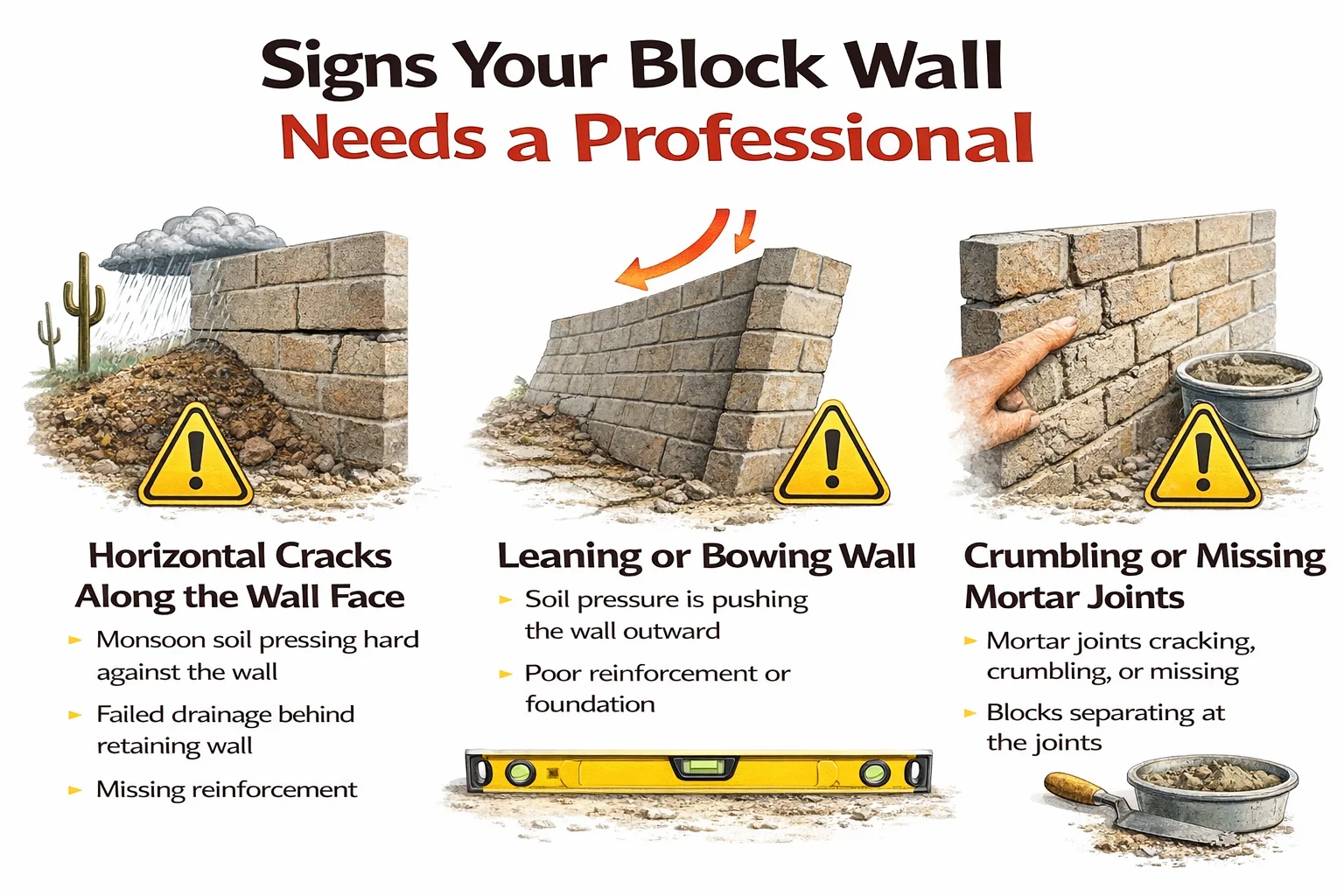
Horizontal Cracks Along the Wall Face
A horizontal crack on any concrete block retaining wall or cement block wall is never a cosmetic issue. It means the wall is under lateral pressure; it was not designed or built correctly to handle it.
The most common causes behind horizontal cracking are:
- Saturated monsoon soil is pressing hard against the wall
- Failed or completely absent drainage behind a retaining wall
- Missing reinforcement from the original construction
Patching the surface does not solve any of those things. The pressure continues to work whether the crack is visible or not, and the wall keeps moving beneath a fresh coat of mortar.
The Wall Is Leaning or Bowing
A block wall that is no longer plumb is already failing. Leaning or bowing means soil pressure, inadequate reinforcement, or foundation movement has already compromised the structure, and a compromised wall will eventually come down. Concrete block wall repair is important when cracks, leaning, or damage start affecting your wall’s strength.
This is not something to monitor over a few seasons. It needs to be assessed immediately. The longer a leaning wall sits unevaluated, the more the repair scope and cost grow together.
Crumbling or Missing Mortar Joints
Mortar is what holds everything together. When it starts cracking, crumbling, or disappearing from joints entirely, the blocks lose their structural connection to each other. The wall may look solid from a distance, but it is quietly separating at every joint line.
Arizona’s heat accelerates mortar deterioration more quickly than in most climates. Daily thermal expansion and contraction stress the joints relentlessly, and monsoon moisture pushes into every weakness it finds. Caught early, repointing is straightforward and affordable. Left too long, entire block sections need to be replaced instead of just the mortar between them.
 Water Is Telling You Something
Water moving through a cement block wall or cinder block wall is never just a visual problem. It means the wall’s integrity has already been compromised through cracked mortar, block porosity, or damage that has been quietly allowing moisture inside long before it became visible on the surface.
The most recognisable signs are white chalky mineral deposits on the wall face, damp patches after rain, and staining that follows crack or mortar joint lines. In Arizona, monsoon season is when most water damage finally reveals itself, and by then, it has usually been working its way in far longer than anyone realised.
Waterproofing concrete block walls is not always complicated, but it must be done correctly. Surface sealing alone rarely solves a drainage problem sitting behind the wall. A professional assessment determines whether sealing, drainage correction, or both are genuinely needed to stop the water rather than simply hide it for another season.
When Blocks Start Breaking Down
Spalling is what happens when moisture gets inside a block, and Arizona’s heat cycle does the rest. The surface flakes, chips, and breaks away as repeated expansion and contraction fracture the material from within. In the desert climate, this process moves faster than most homeowners expect.
Once spalling begins on a concrete block wall, it tends to accelerate. The exposed interior absorbs moisture even more readily than the sealed surface ever did, and the damage spreads outward from each affected block. Individual spalling blocks can often be replaced without full wall reconstruction, provided the underlying structure is still sound, and the damage has not spread beyond what appears on the surface.
Retaining Walls Need Extra Attention
Block retaining walls carry a load that standard boundary walls simply do not. They are actively holding back soil, and any structural weakness carries bigger consequences than it would on a fence wall.
Signs that a concrete retaining wall needs immediate professional evaluation:
- Soil is visibly pushing or bulging through the wall face
- Drainage outlets that are blocked, damaged, or never existed
- Cracking concentrated near the base where soil pressure peaks
Interlocking retaining wall blocks and precast retaining wall blocks can sometimes be reset or reengineered without full demolition, provided the problem is caught before complete structural failure. Once a retaining wall begins to rotate or collapse, the repair scope grows dramatically, and so does the cost of everything attached to it.
The Repair That Keeps Coming Back
If the same section of your wall keeps failing, patches cracking again, mortar falling out in the same spot, a previously repaired crack reopening and growing wider, the root cause was never properly addressed the first time.
Repeated surface repairs on a structural problem are money spent more than once for a result that never actually holds. A professional inspection after a failed repair identifies what was missed initially and provides a solution built to last, not just look fixed for a season or two.
What a Professional Actually Looks For
A proper masonry inspection goes well beyond the visible surface. A qualified contractor examines crack patterns across the full wall length, checks plumb and alignment from base to top, evaluates mortar joint condition throughout, looks for evidence of water infiltration, and assesses soil pressure and drainage at the base of the wall.
From that full picture comes a clear recommendation. Some walls need targeted repointing. Others need reinforcement or drainage correction. A smaller number needs partial or complete rebuilding. Knowing which category your wall falls into before work begins is what separates a repair that lasts from one that gets repeated next season.
Retaining wall repair should be done early to prevent soil pressure from causing serious structural problems.
Why Waiting Always Costs More
The gap between early-repair cost and delayed-repair cost is rarely small. A deteriorating mortar joint caught early is a simple repointing job. After two monsoon seasons, it becomes a block replacement. A slightly leaning wall assessed now might need reinforcement. If ignored for another year, it may require complete demolition.
Arizona’s climate does not pause while decisions are being made. Heat cycles, monsoon pressure, and soil movement work on every weakness every single day. The window for affordable repairs closes faster here than almost anywhere else in the country.
Protecting Your Wall Before Problems Start
The most cost-effective repair is the one you never need. A few consistent habits keep block walls and concrete block walls in far better shape over the long run.
Inspect mortar joints once a year before monsoon season arrives. Clear drainage channels before heavy rain. Keep soil from building up against wall bases and direct downspouts away from wall foundations. Addressing small cracks right away before the next heat cycle gives them a chance to widen into something more serious.
Annual inspection takes less than an hour. Skipping it for a few years can cost thousands. The math is not complicated.
Final Thoughts
A block wall in good condition is something most property owners never think about, and that is exactly the goal. The warning signs in this guide are not meant to cause alarm. They are meant to give you the knowledge to act at the right time, before a manageable repair quietly becomes an expensive structural project.
Horizontal cracks, leaning sections, crumbling mortar, and water infiltration are all fixable. They are always simpler and cheaper to address when caught early rather than after another Arizona summer has had its way with them.
If you are seeing any of these signs on your property, the next step is an honest assessment from a team that understands Arizona masonry conditions inside and out. Our masonry contractor in Tucson, AZ, evaluates block walls throughout the region every day and can clearly tell you what your wall needs and what it will realistically cost to fix it right.
Your wall protects your property. Take care of it before it starts asking you to.